Audio
"Ripieno" - National Symphony Orchestra. Part I
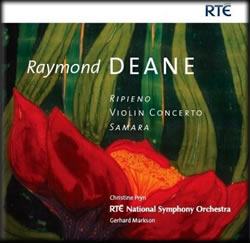
In the Baroque concerto grosso, the term ripieno referred to the full orchestra as opposed to the concertino or group of soloists. I chose the word as the title of this large-scale work without a soloist, as so many of my earlier orchestral compositions had been of a concertante nature, and I wished to avoid the compromising terms symphony or concerto for orchestra. However, given its etymological proximity to replenish, the title evokes the possibility of an aesthetic of plenitude as against one of impoverishment; of dialectic, drama and perspective as opposed to the flat surface of post-modernism. Can this be done without lapsing into nostalgia? Ripieno sketches four possible answers - which may themselves be questions.
Part I begins with a hushes trio for flutes, adumbrating much of the pitch-material on which the work will be based. The entry of lower strings touches a chord that will recur at key points of each movement and that I nick-named the golden chord, although I have never explored whether its occurrences correspond in any way to the mathematical golden section (which I have used consciously in certain other works). The music speeds up and becomes hectic before yielding to a hushed passage alternating celesta and solo strings. This in turn yields to a recurrence of the hectic material which brings the movement to a forceful close.
Part II is a kind of "Intermezzo" whose ingredients include fragments of Klangfarbenmelodie, staccato chords in the low registers, arpeggios in woodwind and pitches percussion, and a good deal of elaborate layering of the string ensemble.
Part III is a frenetic, fragmented "Scherzo" in which pitched percussion and piano - a kind of "gamelan from hell" - function almost as a concertino against the rest of the orchestra. The pitch-structure is characterised by gapped scales and superimposed major and minor thirds, thus anticipating Samara.
Part IV - the longest movement - is a kind of Passacaglia in which each section is centred on one of 14 pitches which are stated at the outset by celesta and harp. The apparent clarity of this scheme is progressively muddied and elements from Part I infiltrate the flow. Somewhere in the back of my mind were W. B. Yeats's lines "what rough beast, its hour come round at last, / Slouches towards Bethlehem to be born?" However, at the end of Ripieno the beast is transformed into shimmering light and disappears into the ether.
The first sketches for Ripieno date from November 1998. Part III, the last to be composed, was sketched in September 1999. The work uses a normal large orchestra - triple woodwind, eleven brass, percussion (without timpani), pianoforte/celesta, harp and strings. The work is dedicated to Colman Pearce, who conducted the premiere on 14 April 2000 and who has tirelessly promoted the cause of new Irish music.
