Audio
"Oboe Concerto" - National Symphony Orchestra
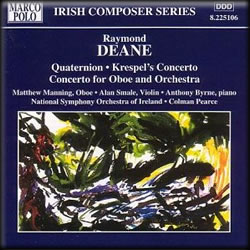
My Oboe Concerto was commissioned by RTÉ (Ireland's national broadcasting corporation) for Matthew Manning, who at the time was lead oboist of the National Symphony Orchestra of Ireland. The work was begun in 1993 after my return from a trip to the Middle East where I had seen many of the camps housing Palestinian refugees, and had passed through Sabra and Shatila, where in 1982 Lebanese fascist militias had massacred thousands of Palestinians under the watchful eye of Ariel Sharon and his Israeli soldiers.
These sights and the reflections occasioned by them influenced the shape of the work. The soloist never plays the role of strutting hero typical of the romantic conerto, but is treated like an exile from the orchestra, the role of which is often oppressive. A soprano saxophone mimics the soiloist from the orchestra, as if it had usurped its place.
While in Richard Strauss's Oboe Concerto, for example, the orchestra is reduced and the musical language correspondingly understated, as if the very use of solo oboe induced neo-classicism, here the soloist faces a full-sized orchestra with triple woodwind, a huge battery of percussion, and organ. The struggle is unequal, and the soloist is often engulfed by orchestral mass – only to emerge bloodied but unbowed.
The third and final movement is nonetheless the only deliberately programmatic one. It begins with a merciless evocation of military/political brutality, through which emerges the harsh sound of the solo oboe's lowest note. Throughout most of the movement the orchestra is chained to its lower register, while the oboe winds its way tortuously upwards. After an episode of sinuous lamentation, the oiboe rises to its highest region at which point the orchestra is released from its confinement, as if the liberation of the exile simultaneously liberates the oppressor . There is a colossal climax which is too jubilant to last and collapses into desolation. Even the oboe's final plaint is taken over by the soprano saxophone, which has the last word.
